
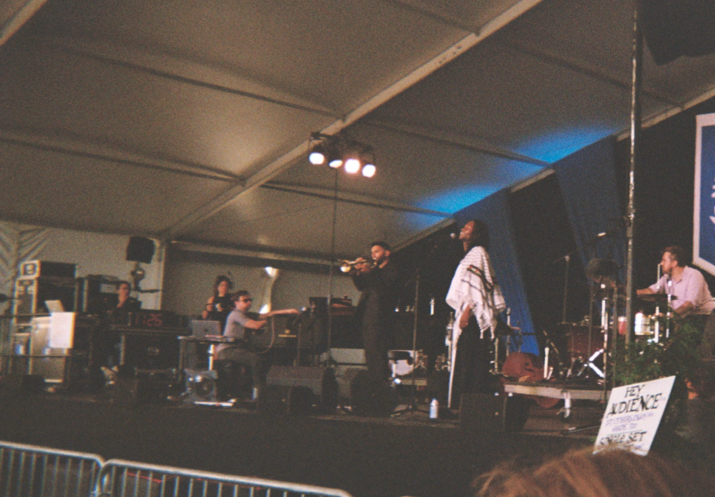
Photo by myself of Riley Mulherkar (Trumpet), Vuyo Sotache (Vocals), Chris Pattishall (Piano), and Jason Berger (Drums)
Sean Fay: Hello, I am Sean Fay and you were listening to ‘jazz died??’ on 89.1 FM WNYU and I’m here with Riley Mulherkar who just had a spectacular set at the Newport Jazz Festival and how would you like to introduce yourself?
Riley Mulherkar: Hey, I’m Riley Mulherkar. I’m a trumpet player, jazz musician, composer and it’s so wonderful to be here at Newport. It’s such a legendary space and so much great community. It’s a beautiful day out here.
S. F.: Yeah, it’s great to be here with you and who are you performing alongside today?
R. M.: So I put together a band to share some music from my debut album and it was a quartet with Chris Pattishall on piano and keyboard, Russell Hall on bass and Jason Berger on the drums and we also had Vuyo Sotache sit in for one song to sing.
S. F.: And before you got on stage, do you have any rituals, any meditation, any way you get prepared to go on?
R. M.: Not too much, I just try to treat it like any other part of life, you know? I try not to put it as a separate thing, just like I drink coffee, I practice trumpet, I share my music, it’s all sort of just part of life.
S. F.: Awesome, and is Newport a noteworthy destination for you and how so?
R. M.: It is noteworthy. Just the history here, knowing all the people who have passed through makes it so meaningful to be here. And then also I’ve been here a few times before, so you start to see some of the same faces and you look forward to it each time. So it’s very special that way.
S. F.: And what would you say any particular cities have influenced your sound or do you have any places you particularly love to perform?
R. M.: I’m born and raised in Seattle and so Seattle has a huge influence on everything about me. I mean not just the music, just the culture, the fresh air, the mountains, the sports, everything about Seattle. And also the musical community, I mean so many musicians I love and some other musicians performing at the festival also come from Seattle. Kassa Overall comes to mind, he’ll be here tomorrow. But I’ve lived in New York for almost 15 years now so definitely that seeps into the music as well.
S. F.: Are there any places that are on your bucket list that you need to perform at?
R. M.: Ooh, I like this question. Bucket list, places… You know I played once at Red Rocks and it was so magical, I would love to go back there. And then you know someday if I could ever play the Village Vanguard, hey that place is sacred.
S. F.: And the next segment I want to go into is about your personal soundscape. It’s a word I use to describe the sounds that surround you, the artists, the musicians, the albums. When you put on your headphones who you’re choosing to listen to first and you mentioned you’re from Seattle, what sort of soundscape did you grow up in and what was your musical involvement there?
R. M.: Yeah, so I mean in Seattle I was a huge into of Nirvana, Mudhoney, a lot of the Grunge music coming out of that city. But I also fell in love with jazz pretty early. So I was listening to a lot of everything from Clifford Brown to Miles Davis to Ellington and Basie and Benny Goodman from a fairly young age, like eight, nine years old. It was pretty heavy into that stuff, you know, singing along, transcribing and all that stuff. So that was definitely the soundscape that set me up early on.
S. F.: Awesome and how would you describe your current soundscape?
R. M.: Hey, current soundscape right now. It’s a lot of Arthur Russell. A lot of, you know, I love everything Sam Amidon does. We just work together on a new track that I’m really excited about, but we were driving up here and listening to a bunch of his music yesterday. Jason Moran is also someone I always look up to. Wynton Marsalis been a big mentor to me since I started playing the trumpet. So there’s a lot of sound going on there. You know?
S. F.: Awesome. Yeah. And what would you say is your favorite soundscape where there’s no music around?
R. M.: Hmm. You know, I was out in, in Vail last week and being out in the mountains early in the morning when you can hear the birds. That’s probably the soundscape, but also a little water too. You can get near some water being from Seattle, the Pacific Ocean. That might be the soundscape for me.
S. F.: Yeah. And if you had to name your own subgenre or your own soundscape, what would you like to call it?
R. M.: Ooh. I don’t know. I see. I never took any marketing courses to go. But anything that feels, I want to feel intimate and tactile, intimate and tactile. So it feels close and you feel like you can engage with the texture of it.
S. F.: Amazing. And regarding your trumpet playing, I’m a trumpet player. Except I grew up playing classical. Did you first play in a classical or in a jazz setting?
R. M.: I always played more in jazz settings. I got more into classical music when I was in high school. I played a lot of orchestral music. And now a lot of my life is playing chamber music. I’ve played a group called The Westerlies and we are basically a brass chamber music ensemble. So we all improvise. We all compose. But it’s very sort of through composed, new music type of playing. So I try to do a little bit of both.
S. F.: Cool. And the next question is what mouthpiece do you use and doesn’t really matter?
R. M.: It doesn’t matter. I actually don’t know what mouthpiece I use. I always played a 3C when I first started in third grade. I had a Bach 3C. And eventually I got a new horn. So I played like the same horn my whole life until right before the pandemic I got a new horn. And my old mouthpiece that I started on didn’t fit quite right. So I took it to Josh Landress, who’s the guy in New York that is the guru for all things brass. And I said I want something like a 3C. And he gave me something and I honestly couldn’t tell you what it is. It feels like the 3C felt but it fits in my horn a little bit better.
S. F.: And I noticed you didn’t play with any mutes, but do you have any favorite mute?
R. M.: I love the plunger. I’ve always loved the plunger.
S. F.: And then if you can share this, I noticed you had a whole bunch of effects pedals up on stage with you. That might be your secret sauce. But-
R. M.: I only had one. I actually only had one. But a lot of the music for the album was pretty carefully. A lot of the sounds were carefully crafted based on each arrangement. So Chris, who was on piano, has a lot of his fingertips on his laptop. And then there are a couple things that I can trigger with my pedal, but it’s all going through his computer. So he has for different songs, different settings. And it’s just on or off.
S. F.: And up next I’m going to have a few more offbeat questions, not entirely music related. But what’s a movie you can always rewatch?
R. M.: Can I give you a TV show? Twin Peaks.
S. F.: And up next, if you’re looking for a food from a truck or a cart, what type of food are you going for first?
R. M.: It is from a truck. I mean, if you can find a Dosa truck, I’m there.
S. F.: And you mentioned you’re in New York. Do you have a go-to bodega/deli order?
R. M.: You know, I used to always go to this spot and I would get sort of like a capresé panini type of situation. But in my neighborhood now, my go-to shop has been a coffee shop rather than a bodega. So I haven’t gotten that bodega over in a few years, which is tragic.
S. F.: How do you take your coffee then?
R. M.: Eight-ounce, black Americano. No room. Hot.
S. F.: Nice. And finally, or well, not finally, finally, of these off-kilter questions, what is the best physical medium for music? Is it CD, vinyl, tapes?
R. M.: Oh. I mean, it’s hard to beat vinyl if you can get it. The tricky thing with vinyl is that you have to have high quality pressing and you have to have a record player that does it justice. Because a lot of record players, there’s a lot of variance in the speed and a lot of vinyl these days is not always produced really well. But if you can find great vinyl, take that over a CD or- You know, tape. I don’t have any way to play a tape. I would love if I hadn’t got that player.
S. F.: Yeah, we have a few in the studio and it’s fun just to make sure they get on the air because a lot of people don’t touch them. And walk me through your creative process where some of the first steps or ideas or people you surround yourself with when you got ready to release your self-titled album?
R. M.: The first step was putting together the music. So I wrote a handful of songs and I picked some old jazz standards that I wanted to approach in a new way. And then step two was putting together a team. So I put together a team with two producers who were close friends of mine. One of whom was Chris Haddishall who was playing piano today. The other of whom is Rafiq Batia who is not here today but he’s an incredible guitarist, producer, sound artist, improviser, and composer. He’s also a member of the band Son Lux. Perhaps best known for their score in the film, “Everything Everywhere All at Once”. But once I assembled the team and I had a sense of the music then we just tried to be really patient with how we put together each song.
S. F.: And it came out great. Do you have any advice for young musicians?
R. M.: Advice for young musicians is to find older musicians and ask them questions.
S. F.: And last but certainly not least is jazz dead?
R. M.: No. No. I don’t think even if you tried to kill it, I don’t think you could. How do you even do it? You can’t. You can’t do it.
S. F.: Alright. And last but not least, anything you want to promote and tell to the listeners.
R. M.: Well for all of you who can’t be here at Newport, if you’re still inclined to give the album a listen, we’d be honored to share that music with you. It means the world to us and we hope it means something to any of you listening.
S. F.: And thank you very much for your time. It’s been great talking with you.
R. M.: So great Sean.
S. F.: Yeah. Thanks for making the time.
R. M.: Thank you.
This was recorded live at the 2024 Newport Jazz Festival on Saturday, August 3rd. Broadcast on 89.1 FM on Thursday, August 8th for ‘jazz died??’.
K3FAY
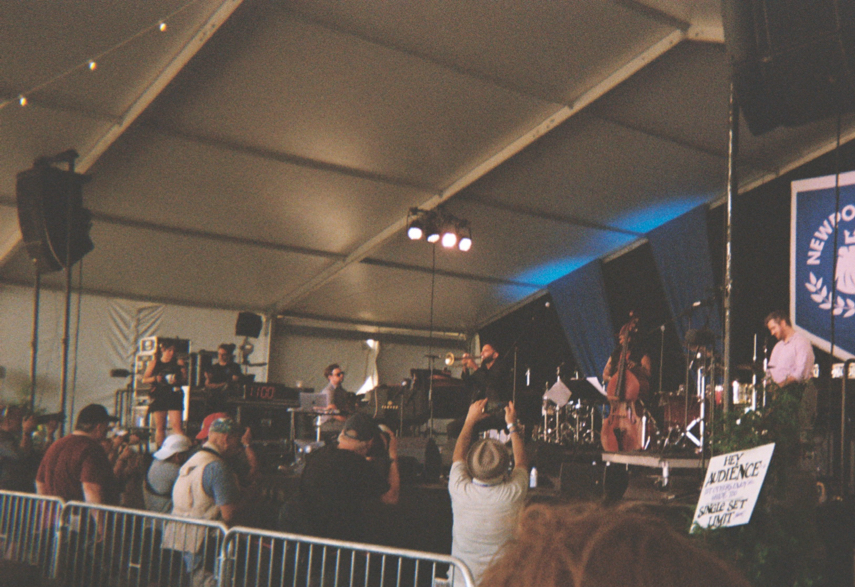
Another photo taken by myself of Riley Mulherkar (Trumpet), Chris Patishall (Piano), Jason Berger (Drums), and Russell Hall (Bass)

