
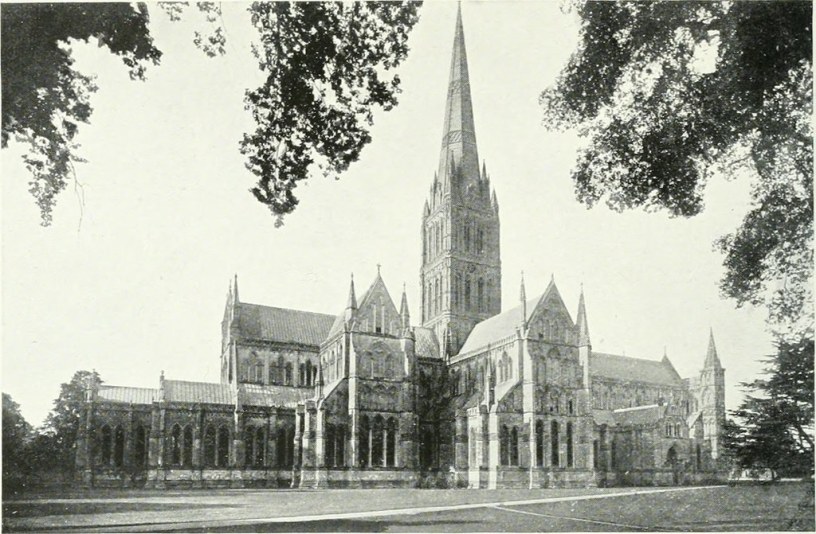
The Muslims were some of the greatest architects to ever grace the Earth. The spire is a staple of Islamic engineering because of how it pointed to the skies where Allah lives. Pointed arches and domes were also critical parts to a mosque’s stability and look. The flying buttress was first created by a Muslim architect as a way of providing stability to pointed domes in a mosque. Stained glass was also used in mosques to provide different emotions to different sectors of the mosque. Just before the gothic architecture era Islam was first starting to gain popularity. This time period was when the gothic building style became mainstream.
Christianity was still exponentially growing just before the Gothic era. New architecture styles were emerging, and the Catholic Papacy thought that their churches needed a redesign. They wanted to make small yet striking changes to their churches. There was also a need for another form of picturing biblical scenes. Previously, stone engravings of various biblical scenes were placed around the church, this was a way to educate the illiterate about the faith. Unfortunately, the intricate details of these engravings were destroyed fairly easily.
Soon several churches were erected with pointed domes which pointed towards the skies where God was. The largest of these domes would typically be around the altar of the church. Pointed arches were also scattered around the church for similar theological reasoning and were more common than the pointed domes, because they were much easier to build and maintain. There are predominantly rounded domes (from the renaissance era) in most churches today. However, the pointed arches are still a common feature to most churches today. The flying buttress was also iconic to a large number of compact churches for their structural support.
One of the first things a passerby will notice of almost every modern church is the stained-glass windows. Although, they did not become popular until the Renaissance era primarily because of their intricacies that were not popular until the Renaissance. These stained-glass windows depict Saints and biblical scenes.
You have most likely detected a pattern between these two descriptions of the mosque and church. They Christian church adopted a large multitude of Islamic architecture. There is no problem with this, but what proceeded is a textbook example of plagiarism. Some Islamic scholars asked the Catholic Papacy to credit them with some of the architectural styles that were imitated. Rather then provide the Muslims with the credit they deserved, Pope Urban VI (a notoriously corrupt Pope) took credit to him self and his league of Bishops for this architecture. In an encyclical published in 1388 Pope Urban VI stated that the uprising architecture of modern churches was an “exclusively Catholic addition”. This encyclical is nearly impossible to find and there are no exact quotes because all paper records were destroyed. These records are solely based off of letters drafted among the Allamah, a group of leaders in the Islamic faith.
This blatant disrespect for another culture’s ingenuity classifies parts of Christian Gothic architecture as one of the most notorious examples of plagiarism ever produced.

