
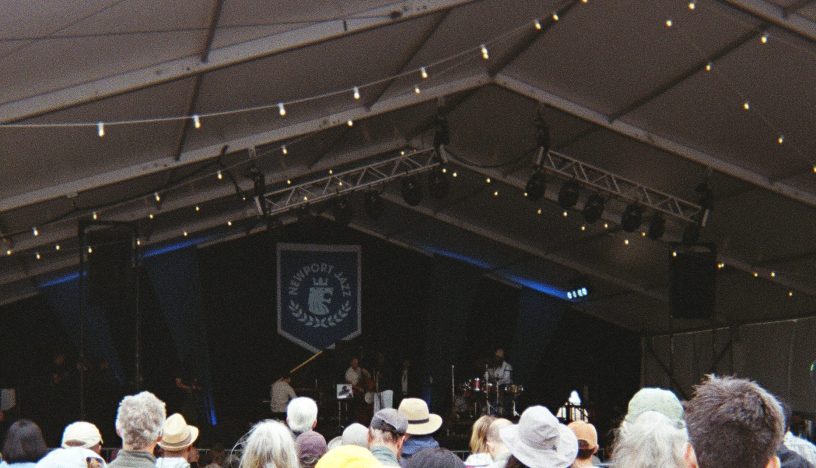
Sean Fay: Hello, I’m Sean Fay, and you’re listening to 89.1 FM, that’s WNYU, and I’m here with Tyreek McDole. How would you like to introduce yourself?
Tyreek McDole: Hey everybody, my name is Tyreek McDole. I would say that I am an artist who emphasizes on the Black American traditions and beyond.
S. F.: Amazing. And you just had a spectacular set over there on the stage here at the Newport Jazz Festival. And who’s on stage with you?
T. M.: On stage, I have some of my closest friends and collaborators. At the saxophone, he’s by way of Philadelphia, Pennsylvania. His name is Dylan Band, one of the baddest tenor players, who now resides in New York. Caelan Cardello from Teaneck, New Jersey, now residing in Harlem. Excellent pianist, has worked with so many masters, studied with the great Bill Charlap. He’s great.
I love working with him. Dan Finn, I’ve known him since I was at the Oberlin Conservatory. And he’s been like a big brother, and he’s just been a real calm, cool, collected force on the bandstand playing the bass. And at the drums, he’s my newest member of my ensemble. His name is Gary Jones III. He’s from Cleveland, Ohio. And we have a common mentor in Paul Samuels, who’s an excellent drummer, genius of just people. And that’s my band.
S. F.: Sweet. I could tell there was great chemistry on stage. Everything melded together spectacularly.
Do you have any rituals you go through or any way you prep yourself before you get on stage to get in the right mindset?
T. M.: Lately, I’ve been trying to do some group huddles. And it’s so terrible because none of us are serious people. We all just start joking, and I’m like, all right, guys, let’s try to get together.
But yeah, I think that’s actually been quite helpful in centering ourselves. Whether it be intense focus or intense humor, whatever it might be, it’s like we are all in it together. And once we hit the bandstand, it’s beautiful.
And I’ve also been trying to breathe a little bit more, being real intentional with the gift that is the breath. And that’s been a really centering thing.
S. F.: I love a good breathing exercise. I was doing them before I got here sitting with you. It just helps you cool down.
And how does Newport compare to those? You just finished a tour. How did it compare to your previous tour destinations?
T. M.: Every single one was so different, but I love each and every one of them. They’re all so special. I was in Austria playing on a farm.
I was in Marciak, which was a huge vineyard, which was great. I also played on the beach the other day. I played in the jazz club at Ronnie Scott’s.
And now I’m here at one of the crown jewels of this American tradition’s institutions. I don’t know. It’s like one of the greatest jazz festivals to take place in the states.
So I’m honored to be here. Already I’m seeing so many heroes of mine who are also Americans, like Kenny Garrett, Ron Carter. Who else is here today?
Aaron Parks was here earlier. There’s just so much great music happening today, and I’m just so happy to be here.
S. F.: Amazing. And would you say there’s any particular cities that have influenced your sound, or is it more the people in those cities?
T. M.: Wow. I mean, if you look at my band alone, they all rep their city very hard. Dylan loves Philadelphia, so you’re talking about John Coltrane. You’re talking about Benny Golson. And, I mean, the list keeps going. Justin Faulkner’s from there, Terrell Stafford.
So you hear some of that in some of the repertoire choices that we make as well as just the soloing choices that we make as well. But I’m a huge fan of artists like Andy Bay, who is from Newark, New Jersey. I’m a huge fan of artists like Joe Williams, who’s from Chicago.
But also Chicago has a great free, quote-unquote, free jazz movement with the AACM. I love the Detroit sound, like Elvin Jones and all the Jones brothers. But I live in New York now.
But more than that, I mean, I’m just an amalgamation of all the sounds that have come through me. My mother’s Haitian. My dad’s American.
So the sounds of the Caribbean are bled into my style, and it’s bled into just jazz, period, or just this American art form that we love because New Orleans was once called the most northern part of the Caribbean. So that kind of implies that not only is it a port city, but these sounds have been imported as well from across the Caribbean, across the world.
S. F.: I love that idea that you’re a mosaic of all the places you come from. Well, one of my next questions was, what’s another spot you’re still excited to perform at?
T. M.: A spot I’m excited to perform? I mean, there’s just so many. I’m so blessed to have the opportunity to work in all these spaces, but I’m looking forward to Japan.
That’s coming up. That’s going to be very exciting. Oh, this island, it’s a French colony off the coast of Madagascar called Réunion.
Incredible. Never even been in that part of the world. Didn’t know it existed until recently, but they got a jazz festival.
S. F.: Awesome. And you’ve kind of mentioned some of the people that mentored you and inspired you already, but how did you come across these people, and what did you look for in a good mentor?
T. M.: Yeah, I’d say I’ve had the great fortune of being a part of so many educational programs that also emphasize on giving back to students that might not have ample funds to pursue the arts. So I’m thankful for just my band program. I went to the St. Cloud Middle School and High School in St. Cloud, Florida, and then I transferred to the Osceola County School for the Arts. They love the music. They have kept it going, and I’m thankful for those institutions, but it keeps going further because institutions like the people themselves, like Rodney Whitaker and Raquel Whitaker, those have been my heroes. I’m thankful for them.
I’m thankful for Wynton Marsalis. I haven’t had much one-on-one time, but because of all of his efforts that he’s done throughout the years, a person like me is able to even have this opportunity of touring, playing the world, studying the music of Joe Williams, Arthur Prysock, so on and so forth. Yeah, there’s just so many people to thank.
S. F.: And I picked up on some of those influences, but not all of them. You’re giving me a good study list. I’m going to have to go through each name after this.
But in your newest album, Open Up Your Senses, the track list was a good amalgamation from sort of all over the place, and I really love that, especially coming up, driving up here. The Umbrella Man was playing while I was in the rain. It was just kind of perfect.
And how did you choose how you built that track list?
T. M.: When it came to selecting the repertoire, I really wanted to focus on the music that made me, the music that I am presently interested in, and the music that I’m hopeful to create in the future. So I was looking through the whole continuum that is this form, this form of Black American music, and also expanding that. So partially, I don’t really identify as a jazz artist as much as I identify as a musician who emphasizes on Black American musical cultures.
But even then, I’m stepping outside. I am Haitian. I’m of Haitian descent.
So I love Caribbean music. I love compa, rara, wawanko, bomba y plena. I love all these forms, and I think that’s a part of the lexicon.
America is a country of immigrants, and we are an amalgamation of a people. So is the sounds of this music. It’s an amalgamation of not only people, but cultures, traditions from around the world.
S. F.: And there was a cool amalgamation of people on that record. Was it all recorded in one sitting? Was it recorded in multiple areas and multiple places?
How did that all come together?
T. M.: Well, I mean, just putting all those people in one room together, I’m a little crazy to do that. But I’m so glad it worked out. It was over the course of two days, and we recorded in studio.
I had the great Sullivan Fortner, Caelan Cardello, Kenny Barron. I had Rodney Whitaker, Justin Faulkner, Dylan Band, Tomoki Sanders, Michael Cruz, Weedy Brima was on the track. All these people I have a personal relationship with.
I know them pretty well as people, and I love their spirit. And I also love their musicality and their artistry. And we all got together quite quickly.
It was kind of short notice, but I’m with a team of killers. So all they had to do was go in, hit play, and then we were ready.
S. F.:And you mentioned on stage that there’s a bit of a thesis to this album. I don’t want to try paraphrasing it myself. Could you inform the listener?
T. M.: Sure. Essentially, my thesis was if we simply open up our senses and reflect upon our own lives, our own humanities, and be vulnerable enough to do so, that can inspire change within ourselves. And that could also inspire change within our neighbor.
And if we do that with our neighbor and their neighbor and their neighbor, that might create a bigger, brighter, more beautiful and humanitarian world for ourselves.
S. F.: It’s beautiful. I love that sentiment. And the next segment of the interview I want to go into, I don’t really know how to tie it.
There’s maybe a way you could tie it together, but it’s about soundscapes and the sounds you surround yourself. And not inherently musical soundscapes, but also ambient soundscapes. What sort of soundscape did you grow up in?
And what sort of maybe non-musical soundscapes do you find yourself drawn towards?
T. M.: Wow. I like that question. That’s interesting.
So I grew up in a small town called St. Cloud, Florida. I say Orlando because nobody knows where it is. I claim them sometimes.
But it kept evolving as I got older and older. It started as cow country. There was nothing but cattle going around.
I grew up, I was one of five houses, and there were a whole bunch of sunflowers around my neighborhood. But slowly, just more people, there was an influx of immigrants that came in. So we got way more Puerto Ricans, we got way more Venezuelans, way more Jamaicans, way more Haitians, and their cultures kind of blend into that.
So I might be on a quiet walk going home, and then you just hear Daddy Yankee just blasting down the street. And I love that. I love that.
People being undeniably themselves and unabashedly just themselves. There’s no shame. I really love that.
In terms of soundscapes, you know, I’m by the water sometimes as well, so I might hear some crickets, I might hear some cicadas, I might hear some gnats buzzing around my head. But I also hear people. I hear mothers and babies and families.
I hear everyone speaking Spanish, Creole, Patois. I’ve always been around, and country music too. I was surrounded by a whole bunch of cowboys.
It was a very interesting, eclectic growing up.
S. F.: And you mentioned that maybe jazz isn’t the best term for the music you like to make. If you had to come up with your own name for your own subgenre, what would you like to call it?
T. M.: Good music? Good music. That’s good.
That’s all, you know, there’s the Louis Armstrongs that is only, or I think it was Louis and Duke had a similar sentiment, there’s only good and bad music. So I’m trying to make the good music. Awesome.
S. F.: And then up next I have some sort of offbeat, you know, grab bag of questions. What’s a movie you absolutely love?
T. M.: A movie that I love? Dang, that’s a really good one. Oh, gosh.
I really love The Princess and the Frog. Sorry, that’s one of the movies that made me play the trumpet and, like, join music in the first place. Because it embodies the spirit of, quote-unquote, jazz, and it was just very optimistic.
But I think what’s beautiful is that it also was a reflection of the city of New Orleans, right? And just how New Orleans itself is a port city, diverse. You get a prince from some random country that doesn’t actually exist, as far as I know, you know, coming to the fray.
As well as, you know, black folks, white folks, Spanish folks, people from all over the place. Love that film.
S. F.: I haven’t seen that movie in a long time. I got to re-watch it. And then you mentioned you’re a New Yorker now. What’s your go-to bodega order?
T. M.: My go-to bodega order? I’ll do a little chicken over rice with the white sauce. I don’t do the red sauce.
It’s too much, man. But I love this question. Yeah, I hit that usually.
Or I get, like, a little turkey sub. I like doing a little cold turkey sub. That’s cool for me.
What’s a drink that I would get? Probably, like, one of those Amazon green teas. You know what I’m talking about?
S. F.: No, I haven’t tried those.
T. M.: Wait, Amazon? Is that the right one? Arizona, Arizona. Give you a little Arizona green tea and get some, like, kettle chips. Call it a day.
S. F.: That sounds good. I’m cautious with that red sauce. Sometimes they put too much on and it’s on fire. And then what’s your favorite physical medium for music? Physical medium for music?
Yeah, so CDs, vinyl, cassettes. You had to build a library, but you only get one.
T. M.: I think I love the experience. So, I mean, I grew up having CDs, and then shortly, like, LimeWire was a thing. Whoops, sorry.
But I think one of my most intimate experiences with music was listening to my grandma’s record player. So, like, I actually got to see and touch a vinyl, and, you know, I put the vinyl on the vinyl player. I drop the needle.
I’m listening to the music, but I’m also reading the liner notes as I’m listening. That’s something that a lot of these apps just don’t do. And I think it’s remiss.
Like, you don’t even know who’s on most of these albums. Like, who’s playing guitar? I don’t know.
You just got to guess. But I think the vinyls help me be more curious. And, I mean, it’s almost like a ritual being able to set that down and, like, just be present, sit in front of a machine that’s here to play music for you.
S. F.: It’s very meditative. I have to thank my grandma, too, because I played around with her vinyl player as a kid, and that’s part of the reason I enjoy the music I do.
And then, to finish up, do you have any advice for young musicians, young aspiring musicians?
T. M.: Wow. I would say whatever you do, do it with the utmost integrity as possible. So if you’re—that might mean that you need to look for people who have walked that path.
If you want to be a great bebop player, if you want to be a great trumpet player, you’ve got to get up with those masters while they’re still here. I mean, I’m in a time where, me as a singer, there’s not a lot of baritone singers or just male singers, period, from the tradition that I could talk to. I can’t talk to Andy Bae.
I can’t talk to Nat King Cole. I can’t talk to a lot of these folks anymore. But, you know, I met Gregory Porter the other day, and he was very warm, very open.
I really appreciate that. I met Kurt Elling a few times as well. Some mentors of mine and big brothers in the scene have been Theo Croker, Maurice Brown, Justin Faulkner.
You know, I mean, get up with older folks who have done some stuff. But also look for your sound and be earnest about that. It’s okay to be alone in your pursuit.
Some people might not like it, but they’re not all here for you. Thelonious Monk died without getting all of his roses. Like, the way that people talk about Monk today is not how they were saying it before.
So yeah, just walk with grace.
S. F.: How long did it take you to find your sound? Because one of the things, I play the trumpet, and I love making noise, but I grew up in the classical scene, and I felt like I can’t put out any of my own music until I make my own sound. And so I’ve been in this years-long process now of just trying to find something that feels like my own.
How did you feel? When did you feel like you got there?
T. M.: I never felt that. I’d say that I’m still in that process. I used to think very similarly that, oh, I have to have all my stuff together, but all my stuff won’t come together until it says I died on my tombstone.
That’s all that could have been said. That’s the peak that I could reach, right? So until then, I’ve just got to keep documenting, keep going, keep searching.
I have to keep searching. There’s a saying that Clark Terry used to say, first you imitate, then you assimilate, then you innovate. So you imitate, you might sound just like another person.
You might sound like Miles Davis or Freddie Hub or Bubba Miley, whoever it might be. Then you assimilate that information, you ingrain it, it becomes a part of you. And you’re coming from a very different perspective.
You like classical music? That’s great. Combine that with all the other sounds, the sounds of your city, so on and so forth, and eventually you will innovate just by being virtual of yourself.
S. F.: That’s inspiring. Thank you so much. So the show I host is called Jazz Died, so I like to ask the question, is jazz dead or how will jazz continue to live?
T. M.: Yeah, yeah, yeah. I think, I mean, I don’t subscribe to jazz, period. It’s okay if you do, but for my own artistic pursuit, I don’t want to be labeled a jazz artist.
But I think this music, you know, the music of Duke Ellington, the music of Bubba Miley, the music of Louis Armstrong, Wynter Marsalis, Nicholas Payton, so on and so forth. It is here to stay. It’s the sound of a people.
People are here. There’s whole festivals around the world about it. So I don’t think it’s going nowhere, but it’s our job to do so with integrity.
It’s not dead.
S. F.: And thank you so much. Is there anything else you’d like to promote, give a shout out to?
T. M.: Surely. Please check out my music. I got an album coming out, and I’ve done some collaborations as well.
So check out Open Up Your Senses, check out Dream Manifest. Theo Croker released that, and I’m on one of the tracks entitled “64 Joints”. I wrote the lyrics to that.
I’m very proud of it. And check me out on my socials. You know, I’m going to have a few shows.I’m doing an album release in New York City at Joe’s Pub on the 6th of August. Come check that out. I’m also performing at Dizzy’s in September, I believe September 21st.
And I’ll be touring all over the U.S. and Europe, so on and so forth. So please stop by and give me a shout.
S. F.: Amazing. Thank you so much. I’ll make sure to stop by to one of those.
T. M.: Oh, and come to Penny Joe’s. I have a jam session every Tuesday in Washington Heights. It’s this little bar. We just play tunes. It’s no stress. Just come hang, come learn, come build community.
S. F.: I love that. Thank you so much.
This was recorded live at the 2025 Newport Jazz Festival on Friday, August 1st. Broadcast on 89.1 FM on Thursday, August 14th for ‘jazz died??’.
K3FAY
 borderline baroque