

Sean Fay: Hello, hello, I am Sean Fay and you’re here listening to 89.1 FM, that’s WNYU. And I’m here with some members of the Moses Yoofee Trio. How would you guys like to be introduced and who am I here speaking with?
Roman Klobe: Hi, I’m Roman. I play bass and guitar.
Moses Yoofee: Hi, I’m Moses, playing piano.
S. F.: Awesome. And how did you guys all start playing together?
R. K.: I saw our drummer playing who is not here right now. I saw him playing on Instagram actually. And I hit him up if he wants to hang out and play and then he agreed. And then I asked Moses to join us. Yeah, that’s basically it.
S. F.: Awesome. And do you guys have any rituals or preparation you like to do before you get on stage?
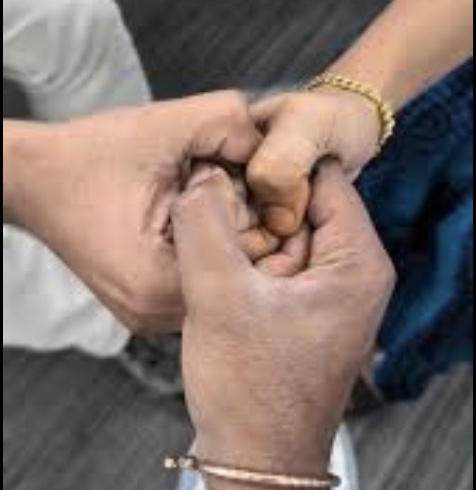
M. Y.: We sometimes put our hands like this. You obviously don’t see it. We put our hands straight facing each other and then go into each other. Like in a… But yeah, just hyping us up basically. All three of us together trying to like get ready for the show. Because we had shows where we just been sitting the whole day and then went to stage. And for me now, I have to like warm myself up, hype myself up. Yeah.
S. F.: And how does performing at Newport compare to the other places you’ve performed before?
M. Y.: I mean, it’s Newport Jazz Festival. It’s not really comparable to what we’ve played before. Because it’s like such a crazy festival with so big history. So yeah, it’s a great honor for us. And we didn’t expect it to be so crowded because we were playing like the first set at 11 in the morning. But people were there and the vibes were really good. And yeah, it was a really special one for us. I agree.
S. F.: Yeah, people line up early in the morning to get here. And I know, I ran. And what are some of the cities that have influenced your sound when you go up on stage? Or the people who have influenced that sound?
R. K.: Cities? I mean, cities. I mean, as we’re from Germany, we haven’t been much around the United States. But obviously our music is heavily influenced from black American music. Also, but also from UK music, like Broken Beats.
M. Y.: London, like UK jazz scene as well.
R. K.: I feel like maybe London, New York, definitely LA. Robert Glasper. Christian Scott. Sorry, not Christian Scott. The Chief. Also, Kaidi Tatham, right? I mean, a bunch of stuff.
M. Y.: It would be like, we couldn’t name people now for like 10 minutes.
S. F.: For ages, yeah. And what are some of the places you’re still excited to perform at? Some bucket list locations.
M. Y.: So for me, like, so one dream is really coming true with us going to Asia this year. So we’re going to do like a run in China, South Korea and Japan. And on my bucket list for me is, as I’ve never been to South America, I really want to go there and see the place. And also maybe Australia, New Zealand, like places which are really far away. Yeah.
R. K.: And also in terms of festivals, like Newport is a bucket list festival. Awesome.
S. F.: Awesome. And then where did you guys find mentorship or inspiration when you were first getting into performing?
R. K.: As a band. As a band or individually? I mean, my mom introduced me to music. Yeah, yeah.
M. Y.: Yeah, for me it was also a lot of my parents like showing me music, like bringing me into certain styles of music. And then when we started like studying and like it was a lot about, for me it was people I grew up with in music, like played. They inspired me heavily. And obviously the teachers we had and the musicians we learned from, the music we listened to, I guess, probably the biggest part. Yeah.
S. F.: And the next group of questions are about soundscapes. So just the sonic environment you find yourself in. And the first one I like to ask is what is a non-musical soundscape you enjoy? So a place where just the ambient noise is something you’re drawn to.
M. Y.: Rain, I guess. Rain. It’s always calming me down.
R. K.: That’s a good question, actually. I never really think about it, but I do like, I like cities, like sounds of cities and they all sound different, you know, kind of. You know, because the, I don’t know, the ambulances sound different in every country also or in every city. And I also like the sound of like in the mountains, like in South Germany or Switzerland in the mountains, there’s a special sound because all the cows have these belts around the neck. Yeah. That’s a nice sound, but I just made it up. I never thought about it before.
S. F.: Nice. I’ve been out to Triberg in Germany. Beautiful.
R. K.: It’s where I grew up next to there, actually.
S. F.: Oh yeah. No, it’s a beautiful location.
R. K.: Yeah.
S. F.: Black Forest.
R. K.: Yeah. That’s where I grew up. Oh, amazing. Yeah. It’s one of my favorite destinations. And I feel like this noise, the ambient noise there is really unique in terms of other forests. It’s much quieter. I don’t know how to describe it.
R. K.: Yeah, it is. It’s interesting because, yeah, I grew up there. But, yeah, it’s definitely quieter. It’s like remote, but also not because it’s very crowded and populated.
S. F.: And then if you guys had to name your own subgenre, I know jazz is kind of a tough bucket to drop artists into. So if you guys had to rename it, and you guys fuse a lot of different elements into your music as well, what would you name that different subgenre?
R. K.: For me, it’s just fusion, actually. Yeah.
M. Y.: I guess, yeah. I don’t know how to name it. It would be like a weird combination of adjectives in order. I don’t know.
S. F.: Go for it. I’ve gotten a list of adjectives.
M. Y.: Okay. Okay. Broken beats. Deep. For me, it’s like deep. I don’t know how emotional.
R. K.: Emotional, broken beat, rock fusion, indie, jazz. I don’t know.
S. F.: That’s good. It’s a mouthful, but it could catch on. And then next, I have some more off-kilter, off-beat questions. What’s a movie you absolutely love?
M. Y.: Interstellar is my favorite movie. I just watched it again on the plane here, and I cried on the plane. I was embarrassed because the guy next to me was, like, wondering what’s up.
R. K.: I don’t have one favorite movie, but a movie that I saw recently that I really like is Mobile the Blues by Spike Lee. Yeah, I just saw that recently, but I don’t have a favorite movie, but it’s a good one.
S. F.: That’s a good one. And then if you find yourself in New York, because our radio station runs out of New York, and you got to go to the deli, the bodega, and order a sandwich or soup or anything, what’s your go-to order at a bodega?
R. K.: I haven’t had it yet, but a person that is very important to me told me I have to try a Reuben sandwich. I don’t know. I never had it, but it’s probably good.
S. F.: It’s a lot of meat. If you like a lot of meat, yeah.
M. Y.: I mean, I don’t know the bodega, really. Yeah, but I don’t know what sandwiches they have, but I would just probably go for a simple chicken or prawn sandwich. Probably prawn. If it’s trustable prawn, then prawn. I really also want to get a lobster roll. Lobster sandwich? Yeah.
S. F.: Yeah, while you’re here. You’ve got to get some lobster, some of the best lobster in the world here. And then what’s your favorite physical medium for music? Do you prefer CDs, vinyl, tapes, and cassettes?
M. Y.: My favorite is a good old WAV on my computer.
R. K.: A WAV file, yeah. I like files as well. I like files.
M. Y.: Not like on Spotify, like on your computer.
R. K.: Like a big file, like one song is like 90 megabytes.
S. F.: We’re making WAV files right now on this little thing.
M. Y.: Vinyl is the sexiest thing. But for me personally, it’s like if you buy the music in this digital world and it’s kind of now you have the track. Also for DJing, maybe that’s why I have this thing to it.
R. K.: Also, I like the bigger tape machines with the big tapes.
S. F.: Those are coming back. I went to an audio engineering festival, and everyone was crowding around them, the 8-track tapes. And do you have any advice for young aspiring musicians?
R. K.: Keep it up. Go through it. You have to go through it. You have to be consistent, I guess. I want to be more consistent. Just keep it up and don’t let other people tell you what to like. Try to find out what’s the thing that you like about music that you personally like, not what other people maybe tell you you should like. Just try to be yourself in that.
S. F.: Awesome. I always end with this question. Is jazz dead, or how will jazz live on?
R. K.: I feel like once a musical genre is in the world, it never goes away. It’s good. Even if it’s bad, it will stay, because there’s always some people there that want to listen to that. And I feel like once a genre is there, it’s going to stay forever.
M. Y.: Jazz is not dead for sure. Look around. I feel like people are attending, old, young. A lot of new people are coming to the scene and making super dope music. So I think it’s developing in a good place. Well, not developing, just there.
S. F.: Thank you so much. Do you guys have anything else you’d like to shout out?
R. K.: Shout out to our boy Noah. He can’t be here right now.
M. Y.: Shout out to our team. Shout out to our team, management, booking agency, people who worked with and for us because they believe in us.
R. K.: Shout out to my mom, too.
M. Y.: Shout out to my dad, as well. I’m going to have to shout out my mom, too, now.
S. F.: Thank you guys so much for making the time. It was a great performance. I hope to see you guys again.
This was recorded live at the 2025 Newport Jazz Festival on Friday, August 1st. Broadcast on 89.1 FM on Thursday, August 14th for ‘jazz died??’.
K3FAY
 borderline baroque